3 Night Beard Transplant in Taksim, Istanbul
A 3-night beard transplant plan is designed for international patients who want to complete consultation, facial hair restoration and the first postoperative checks during a short stay in Istanbul.
This guide explains the typical four-day itinerary, FUE beard transplant process, graft planning, recovery and the questions to consider before travelling.
What Is a 3-Night Beard Transplant Plan?
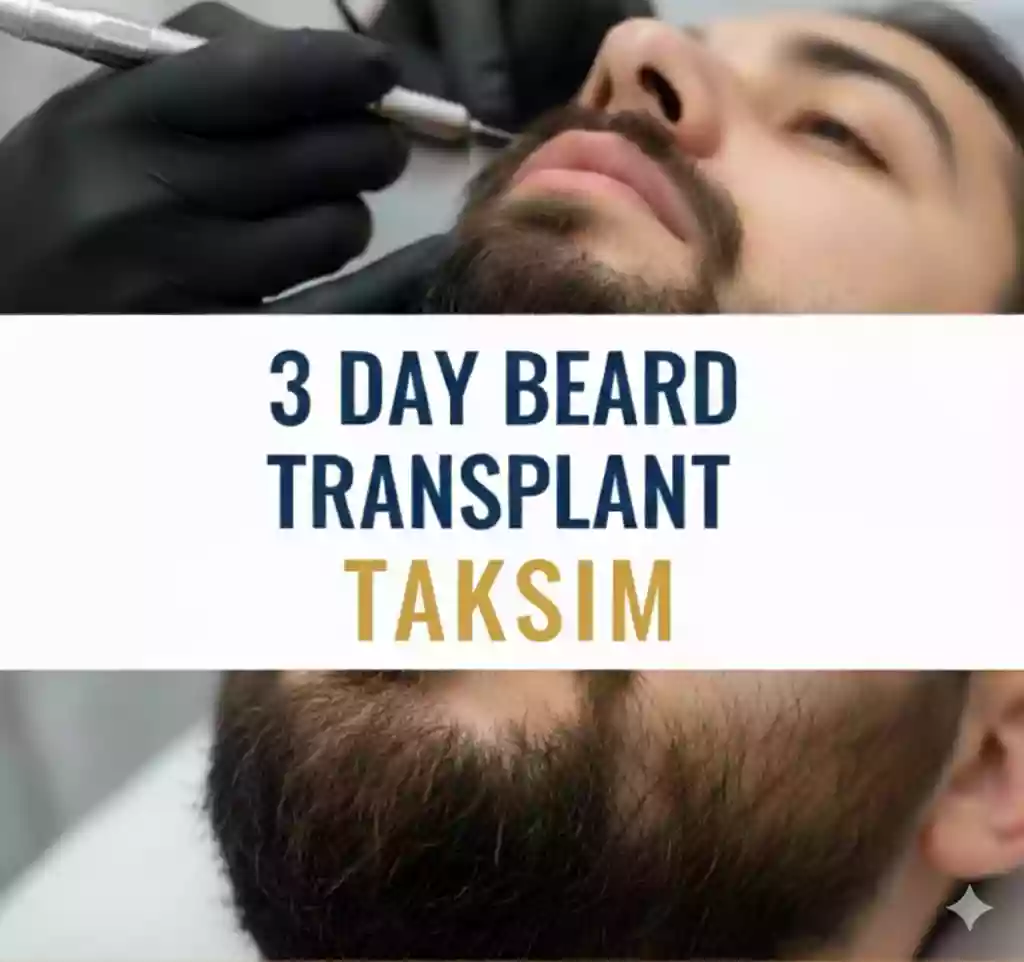
The original treatment plan is structured around a four-day, three-night stay. The purpose is to allow an international patient to complete the main procedure and essential early postoperative checks before travelling home.
A short itinerary does not mean that beard transplantation itself heals in three days. Most of the recovery and hair-growth process continues after the patient returns home.
 +
+A Typical Four-Day Itinerary
Airport arrival, transfer, hotel check-in and preparation for the procedure. Consultation and final planning are completed according to the clinic schedule.
The beard or moustache design is reviewed, the donor area is assessed and the planned grafts are extracted and implanted under local anaesthesia.
The early postoperative area is checked and the patient receives the appropriate washing and aftercare instructions according to the treatment protocol.
A final early-stage review can be completed before departure, together with instructions for continuing recovery at home.
Why Choose Taksim, Istanbul for a Beard Transplant?
Taksim is a central part of Istanbul with extensive hotel, transport and service options. For an international patient staying only a few nights, location can be an important practical consideration.
The quality of a beard transplant, however, should not be judged by location alone. The medical team, donor assessment, facial-hair design, implantation technique and postoperative care are more important than the district name.
How a Beard Transplant Is Performed
Beard transplantation uses follicular units harvested from a suitable donor area and places them into selected areas of the beard, moustache, goatee, sideburns or cheeks.
The source article describes an FUE-based approach. The exact implantation method and surgical plan can vary according to the patient’s facial hair, donor characteristics and the technique selected by the treating team.
Why Angle and Direction Are Important
Beard hair often grows at a relatively acute angle to the skin and its direction changes across different parts of the face. The cheek, jawline, moustache and chin therefore cannot simply be treated as one uniform recipient area.
Planning should take existing facial hair into account so transplanted grafts can integrate visually with the patient’s natural growth pattern.
How Many Grafts Are Needed for a Beard Transplant?
There is no single graft number for every beard transplant. The requirement depends on whether the goal is to fill small patches, improve an existing beard or reconstruct broader facial-hair coverage.
The original source provides broad examples ranging from approximately 500 grafts for limited work to 2,000 or more for extensive coverage. These figures should be treated as general examples rather than a fixed prescription for an individual patient.
Donor Area Assessment
The scalp is commonly considered as a donor source for beard transplantation. Donor density, hair calibre, follicular characteristics and previous hair transplantation can all affect how many grafts can reasonably be harvested.
A conservative donor plan is especially important when a patient may also require scalp hair restoration in the future.
Beard Transplant Recovery and Growth Timeline
The first few days are primarily about protecting the newly implanted grafts and following the postoperative washing instructions. Redness, small crusts and temporary sensitivity can occur in the recipient area.
The implanted area needs careful protection. Touching, rubbing and unnecessary pressure should be avoided according to postoperative instructions.
Crusting generally resolves progressively during the early recovery period. Washing and crust-removal instructions should follow the clinic’s individual protocol.
Many transplanted hairs can shed during the early weeks. This does not necessarily mean that the follicular units themselves have been lost.
Early new growth may begin to become visible, although timing and density vary between individuals.
The developing beard may become more noticeable, but it is still too early to judge the final appearance in many cases.
A more meaningful assessment of overall growth, distribution and maturation can usually be made around this stage.
Who May Be a Candidate for Beard Transplantation?
Beard transplantation can be considered for different patterns of limited facial-hair growth. The reason for reduced beard density and the quality of the available donor area should be evaluated before treatment.
When Further Assessment May Be Needed
Not every area of beard loss should automatically be treated with transplantation. Sudden, unexplained or active facial-hair loss may require appropriate medical assessment before surgery is considered.
The final decision also depends on whether the donor area can provide suitable grafts without unnecessary overharvesting.
What Should Be Confirmed Before Travelling?
A short international treatment schedule works best when the important clinical and logistical questions are clarified before arrival.
For a broader explanation of extraction, donor planning and transplantation principles, see our Hair Transplant Guide.
Beard Transplant in Taksim, Istanbul
Taksim is located on Istanbul’s European side in the Beyoğlu district and provides convenient access to hotels, restaurants and major transport connections.
For a three-night treatment schedule, staying close to the actual treatment location can reduce unnecessary travel immediately before and after the procedure.
Always confirm the exact hospital or clinic location before selecting accommodation, as providers using “Taksim” in their description may operate in nearby districts.
Frequently Asked Questions About a 3-Night Beard Transplant in Taksim
1Is a 3-night stay enough for a beard transplant?
2How many grafts are needed for a beard transplant?
3Is FUE suitable for beard transplantation?
4Does a beard transplant look natural?
5Is a beard transplant performed under local anaesthesia?
6When does transplanted beard hair start growing?
7When can I shave after a beard transplant?
8Can a beard transplant be combined with a scalp hair transplant?
Planning a Short-Stay Beard Transplant in Istanbul
A 3-night beard transplant itinerary can provide enough time for arrival, treatment and the essential early postoperative checks when the individual case is suitable for a short-stay schedule.
The more important decision is the treatment plan itself: realistic graft requirements, conservative donor management, facial-hair design and precise control of implantation direction. Final graft numbers and procedural details should be confirmed after individual assessment.