
DHI VS SAPPHIRE FUE HAIR TRANSPLANT IN TAKSIM: WHICH TECHNIQUE IS RIGHT FOR YOU?
Choosing the right hair transplant technique is the most important decision you will make before traveling to Istanbul for your procedure. In Taksim, the two leading modern methods are DHI (Direct Hair Implantation) and Sapphire FUE. Both deliver natural results, both are performed at world-class facilities like Kolan International Hospital, and both attract thousands of international patients to Taksim every year. But they are not identical, and the technique that suits one patient may not suit another.
This guide breaks down exactly how DHI and Sapphire FUE differ, who each technique is best for, what they cost in Taksim in 2026, and how to make the right choice for your hair loss pattern, lifestyle, and goals.
UNDERSTANDING HAIR TRANSPLANT TECHNIQUES IN TAKSIM
Both DHI and Sapphire FUE evolved from the classic Follicular Unit Extraction (FUE) method. The fundamental principle is the same: healthy hair follicles are harvested individually from the donor area, typically the back and sides of the scalp, and implanted into the thinning or bald regions. The difference lies in the tools used and the way grafts are placed.
Clinics in Taksim, particularly those operating within Kolan International Hospital, offer both techniques. The decision is rarely about which method is “better” overall. It is about which method is better for you.
WHAT IS DHI HAIR TRANSPLANT?
DHI, or Direct Hair Implantation, is a refined version of FUE that uses a specialized medical pen called a Choi Implanter. With DHI, the surgeon extracts hair follicles one by one from the donor area and loads them directly into the hollow needle of the Choi pen. The follicle is then implanted into the recipient site in a single motion, without creating separate incisions beforehand.
This single-step process is what defines DHI. The surgeon controls the depth, angle, and direction of every implanted hair with millimetric precision. Because the follicle spends less time outside the body, the survival rate of grafts is exceptionally high.
DHI is especially effective for:
Patients who want maximum density in a localized area, such as the crown or the hairline.
Patients undergoing unshaven hair transplants, where only the recipient area is trimmed and the existing hair is preserved.
Women experiencing diffuse thinning, who cannot or do not want to shave their entire scalp.
Younger patients with moderate hair loss who prioritize natural front-line design.
The trade-off is that DHI is slower and more labor-intensive than other techniques, which makes it generally more expensive. It is also limited in the number of grafts that can be transplanted in a single session, usually between 2,500 and 3,500 grafts.
WHAT IS SAPPHIRE FUE HAIR TRANSPLANT?
Sapphire FUE is a modern evolution of the standard FUE technique. The extraction phase is identical to classical FUE, but the recipient site is opened using blades made from genuine sapphire crystal rather than traditional steel blades.
Sapphire blades are sharper, smoother, and more precise than steel. They create V-shaped microchannels that cause less tissue damage, less inflammation, and less scabbing during recovery. The cleaner channels also allow the surgeon to implant grafts closer together, producing denser, more natural results.
Sapphire FUE is especially effective for:
Patients with advanced hair loss who require large sessions of 4,000 to 5,000 grafts in a single day.
Patients prioritizing fast recovery and minimal post-operative redness.
Men with classic male pattern baldness affecting the hairline, mid-scalp, and crown.
Patients who want a competitive price point without sacrificing quality.
Sapphire FUE typically takes between 6 and 8 hours per session. Because the technique is faster than DHI per graft, it allows larger sessions in a single day, which is one of its main strategic advantages.
DHI VS SAPPHIRE FUE: KEY DIFFERENCES AT A GLANCE
The clearest way to understand the choice is to compare the two techniques side by side across the factors that actually affect your result.
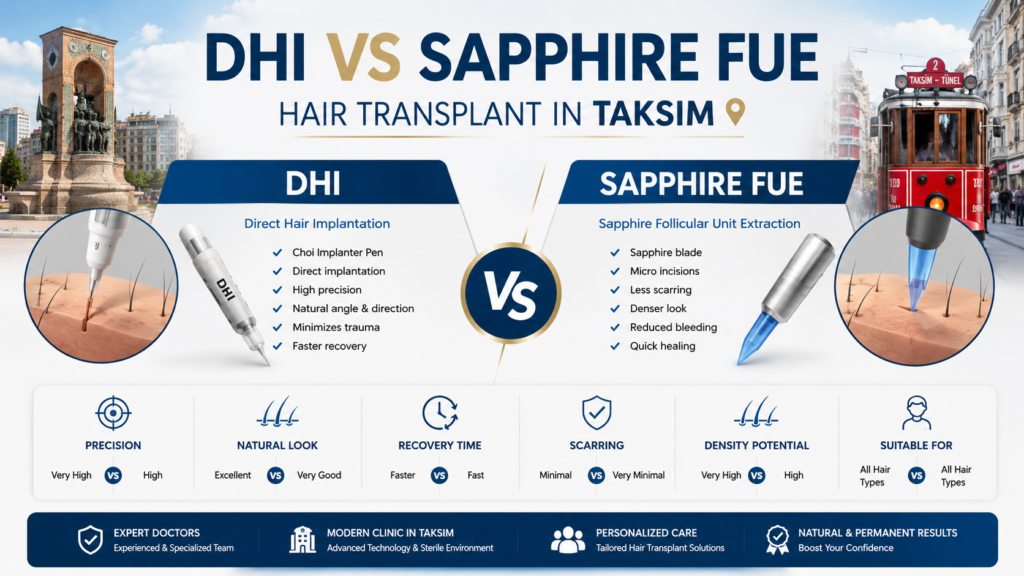
Tool used: DHI uses the Choi Implanter Pen. Sapphire FUE uses sapphire-tipped blades and forceps for implantation.
Incision method: DHI implants directly without pre-opened channels. Sapphire FUE opens microchannels first, then implants grafts into them.
Density achievable: DHI can achieve slightly higher density in small, focused areas. Sapphire FUE achieves excellent density over larger zones.
Maximum grafts per session: DHI typically 2,500 to 3,500. Sapphire FUE up to 5,000 in experienced hands.
Procedure time: DHI 8 to 10 hours. Sapphire FUE 6 to 8 hours.
Shaving requirement: DHI can be performed unshaven. Sapphire FUE usually requires full shaving.
Recovery time: Both heal in 7 to 10 days, but Sapphire FUE tends to scab and redden slightly more in the first week.
Cost in Taksim 2026: DHI is typically 20 to 35 percent more expensive than Sapphire FUE.
WHICH TECHNIQUE IS RIGHT FOR YOU?
The honest answer depends on three things: how much hair loss you have, whether you can shave your head, and your budget.
Choose DHI if you have moderate hair loss confined to specific zones, you cannot shave your head for personal or professional reasons, you are a woman with diffuse thinning, or you want absolute precision on the front hairline. DHI is the right choice when finesse matters more than volume.
Choose Sapphire FUE if you have advanced hair loss requiring large coverage, you need 4,000 grafts or more in one session, you are comfortable shaving your head, or you want strong results at a more accessible price point. Sapphire FUE is the right choice when volume and value matter most.
In many Taksim clinics, including those at Kolan International Hospital, both techniques can be combined in the same procedure. For example, the front hairline may be reconstructed using DHI for maximum precision, while the crown and mid-scalp are filled using Sapphire FUE for density. This hybrid approach is increasingly popular among international patients seeking the best of both worlds.
DHI VS SAPPHIRE FUE PRICES IN TAKSIM 2026

Pricing in Taksim is one of the strongest reasons international patients choose Istanbul over London, Berlin, or Dubai. While exact figures depend on the number of grafts and the inclusions of your package, the typical 2026 ranges in Taksim clinics are:
Sapphire FUE: 1,800 to 2,800 euros for a complete all-inclusive package.
DHI: 2,500 to 3,800 euros for a complete all-inclusive package.
Hybrid DHI plus Sapphire FUE: 3,000 to 4,200 euros depending on graft distribution.
These packages generally include the surgery itself, blood tests, anesthesia, post-operative medication, PRP sessions where applicable, hotel accommodation in central Taksim, VIP airport transfers, and translation services. For comparison, the same procedure in the United Kingdom typically costs between 8,000 and 15,000 pounds, and in the United States between 10,000 and 18,000 dollars.
BOTH TECHNIQUES AT KOLAN INTERNATIONAL HOSPITAL
Micro FUE Turkey performs both DHI and Sapphire FUE procedures at Kolan International Hospital, a JCI-accredited facility recognized as one of Turkey’s leading VIP medical destinations. The choice of hospital matters as much as the choice of technique. Hair transplants performed in unlicensed clinics, no matter how attractive the price, expose patients to infection risk, poor graft survival, and complications that may be impossible to reverse.
JCI accreditation guarantees compliance with international sanitary standards, properly sterilized instruments, certified anesthesiology support, and traceable surgical records. For international patients traveling from Europe, the Gulf, or North America, this level of accreditation provides legal and medical peace of mind that no clinic-grade facility can match.
WHAT TO EXPECT DURING YOUR PROCEDURE IN TAKSIM
Whichever technique you choose, the day of the procedure follows a similar structure. You arrive at the hospital in the morning. Blood tests confirm you are fit for surgery. The surgeon designs your new hairline in consultation with you, marks the donor and recipient zones, and answers any final questions. Local anesthesia is administered, after which the procedure itself is painless.
Extraction takes between 2 and 4 hours depending on graft count. After a lunch break, implantation begins. You can listen to music, watch films, or use your phone throughout. By late afternoon or early evening, the procedure is complete and you return to your hotel for rest.
RECOVERY AND RESULTS
Recovery in Taksim is comfortable. Patients typically stay 3 to 4 nights in the city, with a follow-up wash and check-up on day 2 or 3. By day 7, scabs have fallen off and the transplanted area looks freshly shaved. Most patients return to office work within 10 days, though strenuous exercise and direct sun exposure should be avoided for at least one month.
Visible new growth begins around month 3 to 4. The full result, with mature density and natural styling capability, appears between month 10 and 14. Both DHI and Sapphire FUE deliver permanent results, because the transplanted follicles are genetically resistant to DHT, the hormone responsible for male pattern baldness.
MAKING YOUR DECISION
The best way to choose between DHI and Sapphire FUE is to start with a free online consultation. Send recent photos of your hairline, crown, and donor area to the clinic. A specialist will evaluate your hair density, donor capacity, and loss pattern, then recommend the technique most likely to achieve the result you want.
For most patients in Taksim, the right choice becomes obvious once they see their personal evaluation. Some are clearly DHI candidates. Others benefit far more from Sapphire FUE. A meaningful number do best with a hybrid approach. What matters is that the technique is matched to your face, your hair, and your expectations, not chosen from a brochure.
Hair Transplant Taksim offers both DHI and Sapphire FUE procedures at Kolan International Hospital, with all-inclusive packages designed for international patients. Contact the clinic via WhatsApp for a free consultation and a personalized treatment plan based on your photos.